Navigating Identity Change of Job Loss with Resilience
When you lose a job, what else do you lose? What might you discover?
Lately, I’ve been going through a big change. It’s not a neat process with a clear start and finish. Instead, it’s making me realize how much of my life was built around a certain role and a particular version of myself.
I’m still in the middle of this change. What stands out to me, both personally and in my coaching sessions, is that the hardest part isn’t dealing with the practical details. It’s asking, “Who am I now?”
If you’re dealing with job loss, a new role, a relationship change, an empty nest, or several changes at once, this article is for you. I haven’t figured it all out; I’m facing the same uncertainty. But from my own experience, I know that, even though this process can be confusing, it can also lead to growth and clarity over time. You’re not alone, even if it sometimes feels that way.
When the Landscape Changes

A woman who lost her entertainment industry career and ended up working retail described her first day on the floor this way: “It’s very shocking. Like I just fell off a cliff and I don’t, I have no flashlight.” (Fortune, February 2026)
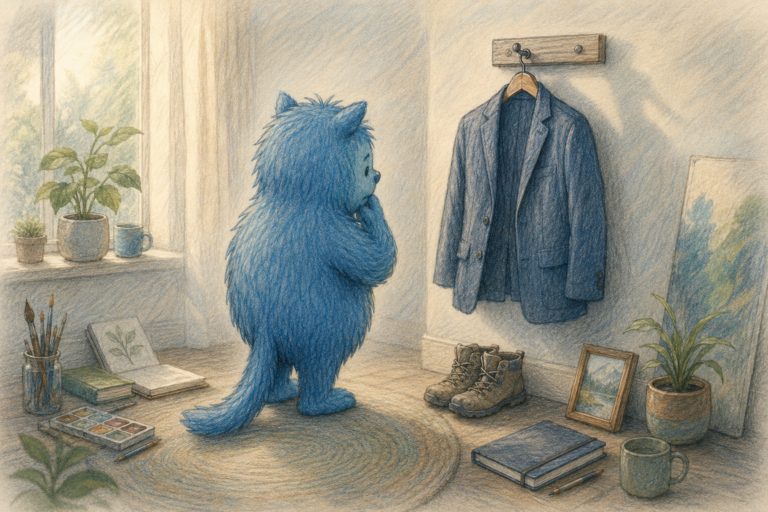
“I have no flashlight” resonated with me. She lost the inner guide that told her who she was, where she was going, and what she was worth. The job was her flashlight, and without it, everything feels unfamiliar.
Layoffs are taking away more than just paychecks. They’re taking away professional identities that took years to build. AI and market shifts are changing which roles exist at all. For many, like this woman, it’s not just losing a job. It’s losing a team, a title, an area of expertise, and a version of themselves they spent years creating.
The job market will change over time. But the question of identity comes up right away. Who am I now?
More than a Job Loss
In American culture, job loss is usually seen as a financial or practical problem. People say to update your resume, refresh LinkedIn, and network. Those steps are important, but if the story above resonates, something deeper is going on.
We all have different sides to who we are—professional, relational, family, and social—and they don’t all matter equally. Often, our professional identity carries the most weight and becomes the main way we see ourselves.
When that identity is suddenly disrupted, our nervous system treats it like a real threat, using the same pathways as physical pain. Meanwhile, the part of the brain that helps us understand ourselves works extra hard to create a new story. If you’re grieving a lost role, it’s not an overreaction. It’s just how our brains respond. Uncertainty keeps us on edge for a long time.
When Everything Shifts at Once
The job market feels especially tough right now because changes rarely happen one at a time. They pile up. You might lose a job while a relationship is struggling. A role might end the same year your child leaves for college. A career change is needed just as a parent needs help.
When several life events happen at once, the disruption to your identity gets even bigger. You’re not just wondering, ‘Who am I without this job?’ You’re also asking, who am I at this stage of life, with these relationships, in this body, and in a world that’s so different from what I expected?
Each change takes energy to adapt, so when many happen at once, your brain gets overloaded. That’s why people feel especially overwhelmed.
In my coaching, I’ve noticed the urge to focus on fixing a specific problem to feel more in control. Maybe it’s finding a new job or solving a practical problem. That’s a natural response, but sometimes it’s a way to avoid deeper identity questions rather than giving them time to unfold.
Professional Identity Purgatory
I came across a phrase: professional identity purgatory. It describes the in-between time after a role ends and before the next chapter becomes clear. It’s not quite limbo—purgatory is a place you move through, and it changes you along the way.
For people who have worked at a high level, entering this uncertain phase can be especially confusing. Their identity was tied not just to a paycheck, but to purpose and making a difference. So, it’s more than just a career change. It takes inner work that job search tips can’t cover.
Psychologist William Bridges explains the difference between change and transition. Change is an external event, like a layoff or a restructuring. Transition is the inner process of letting go of your old self and slowly becoming someone new. Change can happen quickly, but transition takes its own time.
There is a risk, though, which Bridges didn’t name but Adam Grant does: identity foreclosure. Grant describes it as settling prematurely into a choice, grabbing the first available answer to the identity question to end the discomfort of not knowing. Identity foreclosure doesn’t cure the crisis. It covers it up. And it can cost years, locking us into a chapter we chose out of fear of the in-between rather than from genuine clarity about what comes next.
To avoid identity foreclosure, the key is to use this time to ask yourself better questions.
Better Questions for the In-Between
Questions about identity can take time and often feel messy. They aren’t solved in one coaching session or with quick fixes. But asking thoughtful questions helps us balance feelings and logic, and can keep us from making choices too soon. Here are some to think about:
- What was I doing when I was at my best? Not the title or function: the problems you were drawn to, the moments when time disappeared, when contributions felt most like you. That data doesn’t evaporate when a role changes.
- What have I been holding onto that I don’t want to bring into the next chapter? Sometimes, what we lose during transitions is actually something we needed to let go of—a role that no longer fits, someone else’s idea of success, or a pace that was too much. Change gives us a chance to choose more carefully what we want to keep.
- Who am I when I’m not being useful at work? This is a tough question. Our sense of worth often gets tied up with what we contribute or produce. The real challenge is finding your value without a job title.
- What new possibilities does this transition offer that weren’t there before? This isn’t about fake optimism, but about real opportunities that might open up. Most of us are already living proof that professional identity changes over time.
- And maybe most importantly: do I have a lack problem or a want problem? This question comes from The Midnight Library by Matt Haig, a novel I recommend to anyone in transition. In the story, the librarian asks the main character this at her lowest point. “Maybe if we fill what’s missing, the original want goes away. Maybe there’s a life you truly want to live.” It’s a question worth thinking about. What are you really missing right now? Could filling that, instead of just trying to get back what you lost, be the start of your next chapter?
Active Resilience during Transitions
Resilience during this time means learning to handle uncertainty. This doesn’t mean passively waiting things out. It’s actively helping your body and mind stay steady enough to explore who you’re becoming.
One way to handle this stress is to give your body small signs that it’s safe, even for a moment. Simple grounding practices, like slow, deep breaths, pressing your feet into the floor, or holding a warm cup of tea, can help you feel calmer. These steps won’t solve all the uncertainty, but they can help you face it with a clearer mind.
Staying connected to others is crucial during this time. It’s common to pull back from others during a transition. Not having a clear answer to ‘What do you do?’ can make socializing feel tiring. But isolating yourself can make your story feel worse. Without others to reflect our story back to us, we often end up believing the worst version: ‘I have no flashlight, and I never will.’ You don’t have to talk about your transition. Having simple, low-pressure conversations can help your brain feel safer faster than almost anything else.
Movement helps too. Taking short walks outside, noticing what you see and hear, or just naming your feelings can also help your brain find balance. It’s also a reminder that you’re still here and capable and have the added benefit of helping your brain process information. If you feel grief while moving, let it happen. Holding back your feelings can make stress last longer, but letting emotions move through you, even a little at a time, helps your body finish what it needs to.
The signposts on your new path might not be old job titles or routines. They could be new skills, values that matter more now, or relationships that support you in new ways. Maybe you find purpose in mentoring, or you get curious about a different field. Noticing these new signs can help you move through the transition with more honesty about what you need and what you want to create next.
The light will return. It won’t happen all at once, but in small moments of clarity as your mind starts to see who you’re becoming. It might even show you a new path you hadn’t expected before everything changed.
To Do

Reflect: What parts of your identity have changed recently—not just at work, but in your whole life? Which losses are you acknowledging? Which ones are you trying to avoid?

Nudge: Answer this question without editing yourself: When I am most myself—not thinking about my role, title, or job—what is really true about me? Write it down and come back to it as an anchor while everything else changes.

Reset: Less about what I lost. More about what I want.
To Read
“The Midnight Library,” a novel by Matt Haig, follows Nora, the main character, as she explores regret, identity, and the lives she didn’t live. It’s a thoughtful look at what it means to choose your life instead of just drifting through it.
To Watch
“What Makes a Good Life? Lessons from the Longest Study on Happiness” by Robert Waldinger is a talk that reminds us, especially during times of career change, what research says really anchors us. (Spoiler: it’s not your job title.)
Next
Next, we explore how to navigate when the “What-Ifs” threaten a Takeover.