We are Gonna Need More Hugs
The headlines lately read like a stress test we didn’t sign up for. War. The price of gas. The economy. A job market that feels like musical chairs with half the seats removed. Climate change continues to affect our habitats, causing baby penguins to drown. And I am watching people start to shut down. It’s just too much.
I get it. I’m feeling the same. Lock the door, keep to yourself, and manage what you can, by yourself. It makes sense, given the very real threats surrounding us from every direction. And it is also, from a resilience standpoint, exactly the wrong move.
If you’ve been following this newsletter, you know I’ve been exploring how we navigate the physical and mental traps of anxiety and inner critics, as well as the external stress coming at us from the world. I’m on a mission to normalize imperfection and change our relationship to stress and anxiety.
As always, I am writing what I need to hear right now. I’ve had another biopsy, another diagnosis, more medication changes, and was part of a recent reduction-in-force last month. I haven’t been writing or posting much, mostly because of time and energy constraints. (And because I needed to read a very resonating book on resilience that I used to ground this next article.) Through it all, a few close friends and family have listened, supported, and walked with me along the trails of our Georgia mountains and through the forest of challenges I’m navigating. The forests are full of wildflowers here, surprising and delightful. Sometimes subtle, and sometimes they pack a punch. And so does my framily (love-punches, that is.)
The “forest bathing”, homemade dinners with friends, and lots of coffee and puppy kisses have helped. I also want to tell you about a young monkey named Punch. Read on to learn how Punch showed us all a moving and poignant resilience story in real-time and how the neuroscience of our ‘Ordinary Magic’ showed up in a very relatable way.
When the world pushes us inward, reach outward
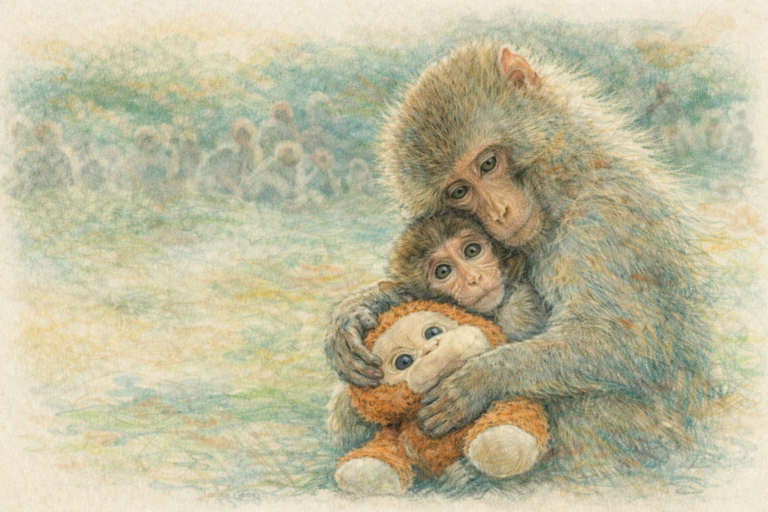
If you have been anywhere near social media in the past few months, you have almost certainly encountered Punch, a seven-month-old Japanese macaque at the Ichikawa City Zoo outside Tokyo. Born in July 2025 during a severe heatwave, Punch was abandoned by his mother shortly after birth and hand-reared by zookeepers. With no mother to cling to, the caretakers gave him a stuffed orangutan from IKEA, a long-limbed, orange plushie called the Djungelskog, to simulate the clinging behavior infant macaques need for both emotional regulation and physical development. What happened next was essentially a global moment.
Videos spread everywhere: Punch dragging his toy across the enclosure; Punch curled around it while sleeping; Punch carrying it toward the other monkeys, who largely swatted him away or ignored him. There he was, a small and bewildered creature, alone in a crowd, hauling a stuffed animal that could not hug him back, trying again anyway.
Millions of people stopped scrolling. Myself included.
Why did it hit so hard? Louie Villalobos, writing for USA Today, noted that Punch’s story resonated because “he reminds us of the loneliness and sadness we’ve felt in our lives from loss or rejection, and the feeling that maybe we weren’t enough.” That is not just projection onto a little monkey; it is recognition of that feeling. We know what it is to reach toward connection and come back empty-handed. We know what it is to hold something: a habit, a routine, a role, that offers some comfort but cannot actually hold us back.
The good news, and it genuinely is good news, is that the story did not stop there. Slowly, cautiously, and with a lot of getting-scolded-by-senior-monkeys in between, Punch began to integrate. He was groomed by another monkey. He chased a younger macaque named Momo-chan around the enclosure. He hitched a piggyback ride on a fellow macaque’s back. This is especially a key social milestone for young macaques. The stuffed toy still makes appearances, especially when Punch perceives danger, but it is no longer the center of his world. Now he has real connections.
The internet, collectively, exhaled. Me too.
In a human, this is the kind of scenario where our inner critics get louder. We interpret disconnection as evidence that we are the problem, rather than recognizing the absence of safe connections. Once that connection happens, as it has with me, during this rough period, regulation begins to restore.
The Lone Wolf Instinct
There is a reason “lone wolf” carries cultural cachet. Self-sufficiency reads as strength. Needing people reads as vulnerability, or worse, as a burden. In a job market where layoffs feel arbitrary and loyalty feels one-directional, pulling inward starts to look rational. Why invest in networks that might dissolve? Why let people into your uncertainty?
This logic has a certain protective shield. And it is also, neurobiologically speaking, working against you. This is what is referred to as “threat rigidity.” Essentially, our brains narrow options to conserve energy and stay safe.
When the brain perceives a sustained threat, which is precisely what a shaky economy, geopolitical instability, and employment insecurity produce, it scans constantly for danger, floods the system with cortisol, and begins to narrow our focus. The cognitive and emotional consequences are significant: sleep suffers; patience evaporates; small problems feel enormous. This is the same system that was driving Punch when he first arrived in that enclosure: alone, overwhelmed, and managing with whatever was available.
What changed Patch’s trajectory was not more stuffed animals. It was other monkeys. We humans do the same thing, substituting productivity, control, or distraction for actual connection. We all need a support system that steps in when we are unable to reach out. That’s what my inner circle has done for me, and what I hope for you.
What the Research Says
Connection is not a nice-to-have. It is a ard biological requirement. Social neuroscientist Matthew Lieberman, in his book “Social: Why Our Brains Are Wired to Connect,” argues that the need for social connection is as fundamental as the need for food and water; the brain treats social pain and physical pain through overlapping neural circuits.
This overlap is why rejection can feel physically painful—not metaphorically, but neurologically.
People with strong social networks recover faster from adversity, demonstrate better immune function, and report higher levels of wellbeing across almost every measure — including during periods of economic hardship and political instability. The mechanism is not complicated: co-regulation. When we are in the presence of people we trust, our nervous systems borrow stability from theirs. The stress response, which can spiral dangerously in isolation, gets interrupted.
The opposite is also true. Loneliness, not just the passing feeling, but the chronic social isolation that underlies it, has been linked to elevated cortisol levels, disrupted sleep, and increased risk of heart disease.
Public health researchers have described chronic loneliness as a health risk on par with smoking fifteen cigarettes a day. Need to find connection again? Reach out at opalcoaching.com
Tweet
Punch was not just sad without a troop. He was physiologically dysregulated. The solution was not motivation or mindset. It was connection. And that was true for me, too; I needed a reset that could not be self-generated.
Getting Started when Connection Is Hard
Connection is genuinely harder in a perfect storm. When you are anxious about money, you may stop doing the things that require spending it — the dinner, the trip, the event. When you are ashamed of a job loss or a financial setback, you go quiet because it feels too uncomfortable to explain. When you are politically, mentally, and environmentally exhausted, as many of us are, you start pre-screening which friendships can survive a conversation about the world, and the math gets discouraging fast.
None of that is a weakness. It is the predictable social withdrawal that accompanies sustained stress. Recognizing this as a ‘normal’ response, given how we are wired, rather than a personal failure, is an important first step toward interrupting it.
What the research suggests, and what Punch’s story quietly illustrates, is that the threshold for “enough connection” is lower than we think. You do not need a large social circle or deep intimacy with dozens of people. You need a small number of relationships characterized by genuine warmth and regular contact. A brief check-in. A walk. A shared meal that does not require pretending everything is fine.
The zoo did not drop Punch into a crowd and expect everything to work out. They first paired him with a gentle young female macaque to build his confidence before his full reintegration. One relationship. That was enough to shift the trajectory. In us, this matters because we often overestimate the scale of effort required to feel better, which keeps us from starting at all.
Staying Connected When It Feels Like Too Much
Below are practices I am returning to, drawn from neuroscience research, and the accumulated wisdom of people who have navigated hard seasons without going it entirely alone.
- Lower the threshold for contact. You do not have to have something to say. You do not have to be fine, or resolved, or caught up. A text that says “thinking of you, no response required” still registers in another person’s nervous system as presence. The bar for reaching out is almost always lower than we set it. Consistency matters more than depth in early reconnection.
- Choose depth over breadth. One or two relationships with real honesty outperform a dozen surface-level connections in terms of resilience. If your social energy is limited right now, invest it in the relationships where you can actually be honest about how things are. This is especially true during burnout or depletion, when social energy is limited.
- Let yourself be witnessed. There is a meaningful difference between telling someone your situation and letting them sit with you in it. The second one requires more vulnerability and is also the one that does the nervous system work.
- Avoid the comparison trap in hard seasons. When jobs are scarce and money is tight, it is easy to assume that everyone else is managing better. They are not. One of the most consistent things I hear in coaching sessions right now is relief when someone else names what they were feeling. Isolation is, in part, a fiction we collectively maintain by pretending we are fine when we are not. (This is the same “Compare and Despair” pattern I discussed in an earlier article, showing up under different conditions.)
- Build community, not just contacts. Community is different from a network. A network is transactional; community is mutual. Community is built through small, repeated acts of showing up: the neighborhood group, the faith community, the standing coffee date, the online forum where people actually know each other’s life events. Community creates continuity, one of the most stabilizing forces in times of uncertainty.
- Accept help without scorekeeping. One way people maintain the lone-wolf posture even within relationships is by refusing to receive more than they give. Letting someone help you is not a debt; it is an act of trust that deepens the relationship for both people.
Being Punch for a While
There is no shame in having been the version of yourself who has been hauling the stuffed animal around. The one managing with whatever substitute comfort was available, reaching toward connection and not always finding it, getting knocked back and trying again anyway.
The zoo’s statement about Punch is worth noting: “While Punch is scolded, he shows resilience and mental strength. When you observe these disciplinary behaviors from other troop members toward Punch when he tries to communicate with them, we would like you to support Punch’s effort rather than feel sorry for him.”
Support the effort. Not the perfect outcome. The trying again after the rejection. The reaching out even when it feels foolish. That is what resilience in a perfect storm actually looks like. Not the absence of need, but the willingness to reconnect even when it is hard.
Punch figured it out. Those of us watching Punch’s story online exhaled with genuine collective relief when he climbed onto another monkey’s back. We were all rooting for him because we recognized the stakes. Connection is the whole thing. If the world feels heavy right now, that is your cue, not to withdraw, but to reach out. I’ll keep figuring it out, and hope you do too.
Below, you will find something to do, read, and watch. I have included one thing to reflect on, a nudge to prompt a resilience practice, and a short thought to reset your resilience. I follow with other sources to continue building your resilience toolkit.
To Do

Reflect: Where have you been lone-wolfing it–at work, in your personal life, or emotionally? What connection have you been deferring because the timing doesn’t feel right, or because you don’t know what to say?

Send the text. Make the call. Keep it simple. Reach out to one person this week without an agenda. Not to network or update them on your situation, just to make contact. Notice what that does to your nervous system. And if someone reaches out to you, respond, simply, but authentically.

Less news. More dogs.
To Read
“Social: Why Our Brains Are Wired to Connect” by Matthew Lieberman. An exploration of why human connection is a biological necessity, not a luxury, grounded in decades of neuroscience research. I’m not selling books, but this is a strong read that costs less than lunch.
To Watch
Why you could be depressed or anxious – Johann Hari. In this widely shared talk, journalist Johann Hari examines the structural forces driving modern loneliness and makes a compelling, research-grounded case for rebuilding real community.
Next
The following article explores navigating loss and grief, using a personal story from friends that illustrates the thousand quieter losses that accumulate when the life you planned no longer quite fits the world you are living in. Keep reading, and as always, let me know what resonates.