Navigating the “What Ifs” with Resilience
How to Overcome Analysis Paralysis
Career transitions have a way of turning decision-making theory into something you live rather than read about. I have been living this article for the past several months.
I have made several decisions about what comes next. Some feel good enough, while others are still unfolding, which may be the most honest description of decisions made during uncertain times. What surprised me was that the what-ifs did not disappear once I chose a direction.
The lesson for me is that decisiveness does not always produce certainty. Sometimes it means making a thoughtful choice while accepting that some questions remain unanswered.
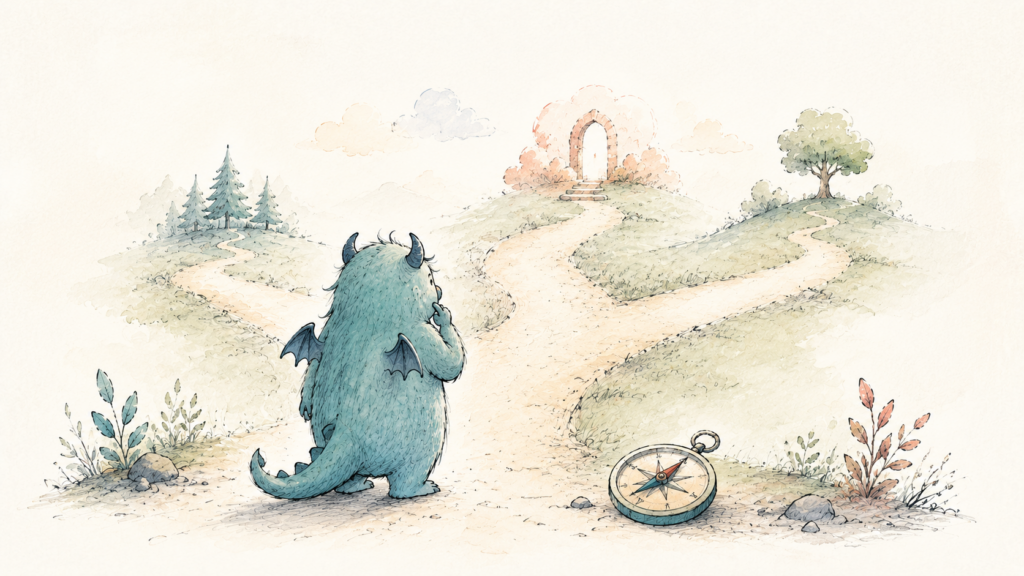
Feeling stuck is not always the result of having no options. Sometimes it comes from having too many. One of my clients described it as standing at an ice cream counter, overwhelmed by every possible flavor and unable to choose one. I strongly relate.
The current job market is giving a lot of people that feeling. AI is transforming industries, and even people who did everything right are facing layoffs. Meanwhile, the number of possible pivots is huge: switching careers, learning new skills, consulting, freelancing, going back to school, relocating, starting something new, or waiting for things to settle. Many people are trying several of these at once.
If you’re capable, curious, and adaptable, that breadth can be its own problem. You can picture yourself succeeding in several directions, but that same flexibility makes it hard to commit to one. What’s usually a strength becomes a saboteur.
This pattern shows up well beyond careers. It surfaces when reconsidering a relationship, deferring a move, or realizing midway through an expensive degree that it reflects someone else’s idea of success.
Indecision can feel safe because it puts off the risk of making a mistake. But staying stuck has its own costs: more stress, missed opportunities, and the slow drain of an unanswered question. You might notice this if you keep asking others for reassurance, wait until something forces your hand, keep gathering information without getting clearer, or go over the same options without learning anything new.
Getting stuck in what-ifs can be a sign that your mind is overloaded. One client came to a coaching session feeling thrown off by her Marie Kondo phase. She could not decide whether to give things to friends, donate them, sell them, or box them up in case she regretted letting them go.
She thought that being more decisive would lower her stress and help her feel clearer. But the real issue was not her things; it was all the what-ifs piling up. Her mind was working harder, but the decision stayed stuck, just like her boxed items.
Read on to learn what might be happening in your brain during uncertain times, the common patterns that can get in the way of good decisions, and what can help you move forward even if some what-ifs remain.
Your Brain on Overload
In Thinking, Fast and Slow, Daniel Kahneman describes two systems involved in how we think. System 1 is fast, intuitive, emotional, and highly skilled at recognizing familiar patterns. System 2 is slower and more deliberate, allowing us to weigh evidence, consider trade-offs, and solve complex problems.
Both are useful. The problem is that prolonged uncertainty gives the faster, threat-sensitive system a great deal to react to.
Things like job instability, money worries, health issues, relationship problems, and big life changes can all make your mind look for danger. It starts coming up with warnings, predictions, and worst-case scenarios, often with more urgency than accuracy.
At the same time, the slower thinking required to compare complex options consumes energy and concentration that may already be depleted. This creates the familiar experience of knowing that a decision needs to be made, knowing that you are capable of making it, and still being unable to gain traction.
Your brain is trying to protect you, but it is built to handle immediate threats, not months of uncertainty and too many choices. Knowing this will not make the decision for you, but it might help you stop thinking your struggle means something is wrong with you. It also helps explain why intelligent, thoughtful people fall into several predictable decision traps.
Four Villains That Derail Decision-Making
When our mental bandwidth is already strained, we tend to fall into a few predictable patterns. Chip and Dan Heath describe four of them in Decisive, and I find the labels useful because they make these habits easier to notice as they happen.
Narrow framing happens when we reduce a complicated decision to two options: stay or go, take this job or have nothing, move or remain exactly where we are.
Simplicity can feel comforting because it gives your mind fewer things to handle. But it can also lead you to ignore other options before you really think them through. Most important decisions have more than two paths, including temporary choices, blended options, experiments, or changes in timing.
Confirmation bias shows up once we become emotionally attached to an outcome. We start noticing the evidence that supports it and quietly dismiss what does not.
We read success stories, talk to people who agree with us, and see uncertainty in ways that support the answer we already want. The more relief or excitement a choice offers, the harder it is to look honestly at what might go wrong.
Short-term emotion can make the feeling of the moment seem like the whole truth. Someone who has just been laid off may feel pressured to accept the first available offer, even when the role does not fit their goals or values. Someone leaving a painful relationship may make another major life decision while still operating from fear, anger, or grief.
Strong emotions are important. They often signal that something needs attention. But they do not always show us the whole picture, especially when we let the strongest feeling decide for us.
Overconfidence happens when we think we know more about how things will turn out than we really do.
We might underestimate how much things can change, overestimate how fast something will work, or avoid preparing for outcomes we do not want to think about. A prediction can feel convincing, even if it is based on very little information.
I have seen all four of these patterns in my own recent decisions, sometimes even in the same afternoon. But just knowing about them does not make us immune. Being aware gives us a chance to stop them before they take over, and that is where the Heaths offer some help.
A Way Through Decision Paralysis
Once we see the patterns that keep us stuck, the next step is to break them. The Heaths suggest a framework called WRAP: Widen your options, Reality-test your assumptions, Attain distance before deciding, and Prepare to be wrong. I like it because it helps with both the practical and emotional sides of tough decisions.
Widen your options. Before choosing between A and B, ask what you would do if neither option were available. The goal is not to create more possibilities to overthink, but to loosen the grip of the original either/or. Someone deciding whether to leave a job might consider renegotiating the role, reducing hours, taking a leave, exploring an internal move, or setting a specific departure timeline.
Reality-test your assumptions. Once we become attached to a particular outcome, we naturally begin collecting evidence that supports it. Ask yourself:
- What evidence might change my mind?
- What could go wrong?
- What am I avoiding because I do not want to find it?
The Heaths also suggest an “ooch,” a small, low-risk experiment that provides real information before a larger commitment. Shadow someone in the role, take one freelance project, volunteer in the field, or spend enough time in a new city to experience ordinary life rather than vacation life.
Thinking things through can help you imagine what might happen, but trying a small experiment lets you actually learn from the experience.
Attain distance before deciding. Creating distance does not mean ignoring your emotions. It gives you enough space to understand them without letting the strongest feeling of the moment dictate the entire decision.
Ask how you might feel about the choice in 10 minutes, 10 months, and 10 years. You can also consider what you would advise someone you love to do in the same situation.
Prepare to be Wrong. A thoughtful decision can still need adjustment. Before committing, decide what would tell you the choice is working, what might cause you to reconsider, and when you will review it.
Most decisions can be changed more easily than they seem at first. Planning to check in and make adjustments can make a choice feel less final and more like a direction you are willing to try.
The Risk of Deciding Too Fast
There is a difference between making a careful choice and just picking the first answer that ends your discomfort.
I have written before about identity foreclosure, which is when we commit to a role, path, or version of ourselves before giving ourselves enough time to explore. Uncertainty can make almost any answer feel like relief, but that does not always mean it is the right choice.
Before deciding, ask yourself: Am I moving toward something meaningful, or merely trying to escape the discomfort of not knowing?
You can read more about identity foreclosure in my previous article.
Decisiveness as a Resilience Practice
Knowing the framework does not make you immune to these patterns, and that might be the most important lesson I have learned. In this context, resilience does not mean making decisions without doubt or eliminating every what-if. It means staying able to function while some uncertainty remains, making the best choice you can with what you know, and trusting yourself to adjust as you learn more.
Even people who are decisive still have doubts. They have just learned that doubt does not always mean you need to wait, and that picking one path does not mean pretending it was the only option.
I am still living with some of my own what-ifs. The difference now is I see them as part of moving through uncertainty without pretending I can see the whole path. The practices below are meant to help you identify where you are stuck, consider the bigger picture, and take a thoughtful next step.
To Do

Reflect: Consider a decision you have been deferring. What is the actual cost of not deciding? Is your hesitation connected to information you still need, or to an emotion you are not yet ready to face?

Nudge: Identify one decision that has been stalled by an either/or frame. What third option have you not seriously considered? What would you tell your best friend to do in this situation?

Reset: “If you choose not to decide, you still have made a choice.” — Rush, “Freewill”
To Read
Decisive: How to Make Better Choices in Life and Work by Chip Heath and Dan Heath. The source for the WRAP framework and the four decision-making traps explored in this article. Practical, readable, and useful well beyond the examples they use.
To Watch
“How to Make Hard Choices,” a TED talk by Ruth Chang. In this 14-minute video, Chang makes a compelling case that hard choices are not always difficult due to a lack of information. Sometimes they are difficult because we are weighing options that reflect genuinely different values, with no objectively superior answer.
That idea is especially useful when further research no longer yields greater clarity. At some point, the question becomes less about finding the perfect choice and more about deciding what you are willing to stand for.
Next
In the next article, I will look at how our fast and slow thinking systems work together and how our ego shapes our perception of risk, status, and change. I hope you keep reading, and I would love to hear what stands out to you.