
Making Boundaries Stick: From Reaction to Response
How to recognize your patterns and build new responses
One of my clients, I’ll call her Emily, came into coaching feeling deeply burned out and unsure if the problem was the job or something else. She was operating across multiple roles, covering gaps, and absorbing pressure from above while trying to protect her team.
Emily didn’t just feel busy; she felt drained and increasingly disconnected from work she had once found meaningful. She described herself as “an over-functioning professional,” someone who could see what needed to be done and usually stepped in to do it, regardless of whether it was her responsibility. Over time, that habit had taken a toll on her energy, her enthusiasm for work, and even her enjoyment of life outside the office.
And the patterns contributing to burnout aren’t necessarily limited to work, either. They show up when we take responsibility for everyone’s holiday plans, keep rescuing a family member from the same problem, or agree to one more commitment because saying no feels harder than finding the time.
In our work together, Emily’s shift started with creating a foundation for interrupting patterns that had been building for years, long enough to choose something different, and then learning how to sustain it.
Read on to learn more about what worked for her.
Over-Functioning Is a Pattern, Not a Personality
Many professionals have built successful careers by being dependable, adaptable, and willing to do what others won’t. Over-functioning can look like competence, initiative, or simply being a good team player. People may not immediately recognize that the strengths that helped them become successful are contributing to burnout. And that makes those patterns particularly difficult to change until, like Emily, the cost begins to outweigh the benefit.
Over-functioning often gets reinforced early because it works: when ownership is fuzzy, we take it, and when conversations stall, we move them forward. The brain, which is always looking for efficient ways to reduce friction, learns that this pattern resolves discomfort quickly, and it begins to default to it under pressure.
Emily was dealing with a steady stream of new requests that interrupted her team’s work, each one carrying an implied urgency. The problem wasn’t that she lacked the ability to manage competing priorities. It was that she had become the person who absorbed the consequences when priorities weren’t managed. Her default behavior was to absorb the new request, translate it into something actionable, and force it into the queue, because no one was re-prioritizing everything else.
Coaching conversations helped Emily recognize her patterns and prepare for situations where she typically absorbed responsibility. The next time an interruption came in, she noticed her usual pull to accept the work, and she paused. And then she pushed back, asking questions about the purpose and priority of the request.
The dynamic shifted almost immediately. Her requester grew a bit defensive. Emily had just changed the script.
Emily proposed a simple intake process for new requests. When the pressure continued, she held her ground and repeated her proposal. And then she stopped talking.
Later, she would describe that moment as intensely uncomfortable. At the time, it didn’t feel like a strategy or a tool; it felt like standing in the middle of incredible tension, resisting the urge to acquiesce and smooth things over. She was practicing the pause we had role played in coaching.
And it worked. The request started to unravel under her questions; what initially sounded urgent and important turned into something far less defined, more of a passing thought than a value-packed objective. Those few seconds gave her the opportunity to respond instead of react, saving her team unnecessary work. And she gained new insights and tools for her boundary work.
Emily had become very good at making everything work. The challenge is that the same pattern that keeps things moving also keeps problems hidden; when Emily consistently stepped in to translate, fix, or absorb work, the underlying issues rarely surfaced clearly enough to be addressed.
Of course, changing her response didn’t make the underlying organizational problems disappear. Emily’s burnout was not entirely the result of her own behavior. She was responding to real organizational problems, and her new boundaries helped make them visible. Awareness and boundaries cannot, alone, fix an unreasonable workload or an unsupportive environment.
Even when we recognize the need for a boundary, holding it can feel very different.
The Discomfort of New Behavior
As Emily learned, the hardest part of holding a boundary isn’t the words; it’s tolerating the tension of leaving the problem unresolved while resisting her normal urge to rescue, translate, or absorb.
Those moments can feel like purgatory. But when you stay in that pause, even briefly, you create the possibility of a different response. That pause is where most people revert to the old pattern, not because they lack awareness, but because the urge to reduce tension is immediate.
In our next coaching conversation, we explored what happened, what she did differently, and why the experience felt so uncomfortable despite the positive outcome. What initially seemed like an awkward exchange became something she could recognize, learn from, and use again.
The Reward
In Emily’s old pattern, the reward was immediate but expensive; tension resolved quickly, but the responsibility landed on her. In her new pattern, the cost was front-loaded; she had to tolerate discomfort in the moment, but the relief that followed was cleaner and more sustainable. She described a sense of incredible lightness that followed the deep discomfort of the interaction.
That lighter feeling is easy to dismiss, especially for people who are used to measuring success by outcomes or external validation; however, from a neuroscience perspective, that feeling can help reinforce the new behavior. It’s deceptively simple: positive outcomes make change more appealing to repeat.
When she consciously registered her shift, she strengthened the likelihood that she would choose the same response again. But it doesn’t guarantee she will remember to respond differently when scenarios come up.
How do you make it easier to remember that new response the next time the pressure is on?
How do you make it easier to remember that new response the next time the pressure is on?
Pre-Deciding Your Response
You are far more likely to hold a boundary when you’ve already decided what you’ll do. In moments of stress, the brain favors efficiency; it defaults to what is familiar unless you have created a clear alternative. When you pre-decide your response to common scenarios you struggle with, you reduce the need to think under pressure. Creating a simple if/then pattern can help.
If I notice [cue], then I will [specific response].
- If someone introduces urgent work, then I will ask what needs to be deprioritized before agreeing.
- If a request is unclear, then I will ask for clarification.
- If something bypasses process, then I will redirect it.
Making Change Stick
What helped make this shift sustainable for Emily wasn’t just the individual moments, but how she began to systematize them. Instead of relying on memory or general intention, she started capturing patterns in a simple, repeatable way: What was the situation, what was done before (old pattern), what was tried instead (new response), and what was noticed.
The Boundary Library is a forward-looking tool, not just a record of past interactions. And the “What I Noticed” section isn’t just about evaluating whether the boundary worked. It’s also a place to record the emotional outcome, including the relief, confidence, or clarity that followed. You can return to it before any difficult conversation and choose a response to practice.
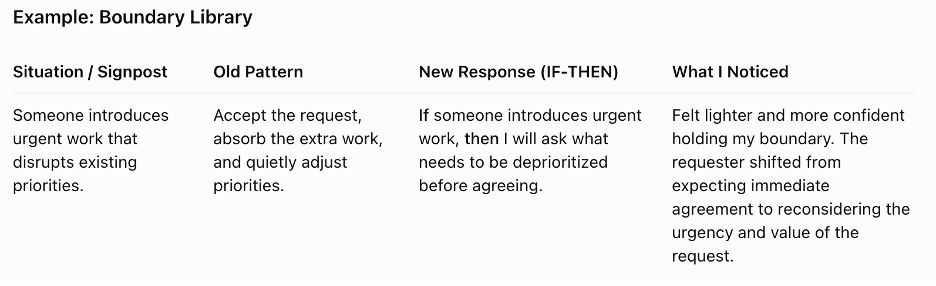
Emily was already recognizing several recurring situations: unclear requests, shifting priorities, conversations that looped without resolution, and moments where ownership was implied rather than stated. Once those cues became recognizable, they became easier to prepare for,
Over time, repetition does what insight alone cannot; it builds familiarity with the new response until it requires less effort to access. What initially feels deliberate and uncomfortable becomes more natural, not because the situations have changed, but because your relationship to them has.
That is the shift from reaction to response; not a single decision, but a pattern built, reinforced, and repeated.
To Do

Reflect: Where am I still stepping in to fix, translate, or absorb something that isn’t mine? What signposts tell me I’m approaching that boundary?

Nudge: Choose one recurring boundary situation and pre-decide your response using an IF-THEN statement. Practice it this week, and afterward, take a moment to notice what happened and how you felt. Add what you learned to your Boundary Library.

Reset: I can let the problem sit without making it mine.
To Read
The Brain That Changes Itself: Norman Doidge explains neuroplasticity in human, story-based ways, and how repeated choices can help reshape neural pathways.
To Watch
Dan Ariely’s TED Salon talk, How to Change Your Behavior for the Better, explores why knowing what’s good for us doesn’t always translate into action, and how changing the friction around our choices can make better behaviors easier to practice.
Next
If you recognize these patterns but still struggle to hold your boundaries, you’re not alone. In coaching, we explore what’s keeping you in those patterns and develop practical ways to protect your energy without abandoning the relationships that matter. If you’re ready to make a change, schedule a free coaching conversation at opalcoaching.com.